
Executive summary
Iconic experienceHigh efficiency / m²Reduced space requirementsImproved energy efficiencySafety and controlHigh hygiene standards
The PoolDesign Thermal Cycle Experience is a modern wellness proposition for hotels, resorts and wellness centers seeking meaningful differentiation. It brings together a complete thermal contrast cycle in a single space, offering an organized guest experience, efficient use of space and clear operational and commercial value.
Discuss spatial integration, functional logic and the possibility of leveraging the solution in your own project.
Unlike fragmented thermal contrast layouts, where the visitor moves between different spaces, the system organizes a guided and continuous experience within a single chamber. This allows for more stable control over temperature, operating conditions and the overall guest experience.
For management and the investor, the result is an experience with a distinct identity, higher efficiency per square meter and more meaningful integration into the overall wellness or recovery offering.
For hotels, resorts and spas evaluating new experiences with clear operational and commercial logic.
Traditional thermal contrast layouts typically rely on sauna, hammam and cold bath in separate spaces, which increases complexity and breaks up the flow of the experience. The PoolDesign Thermal Cycle Experience condenses the cycle into a single installation with more rational use of space and more stable operational control.
The unified architecture reduces friction for the user, enhances product clarity for the market, and helps a unit deliver a more recognizable experience with a stronger brand identity.
The system is based on a programmed four-phase cycle so that the experience remains readable, controllable and stable in everyday operation.
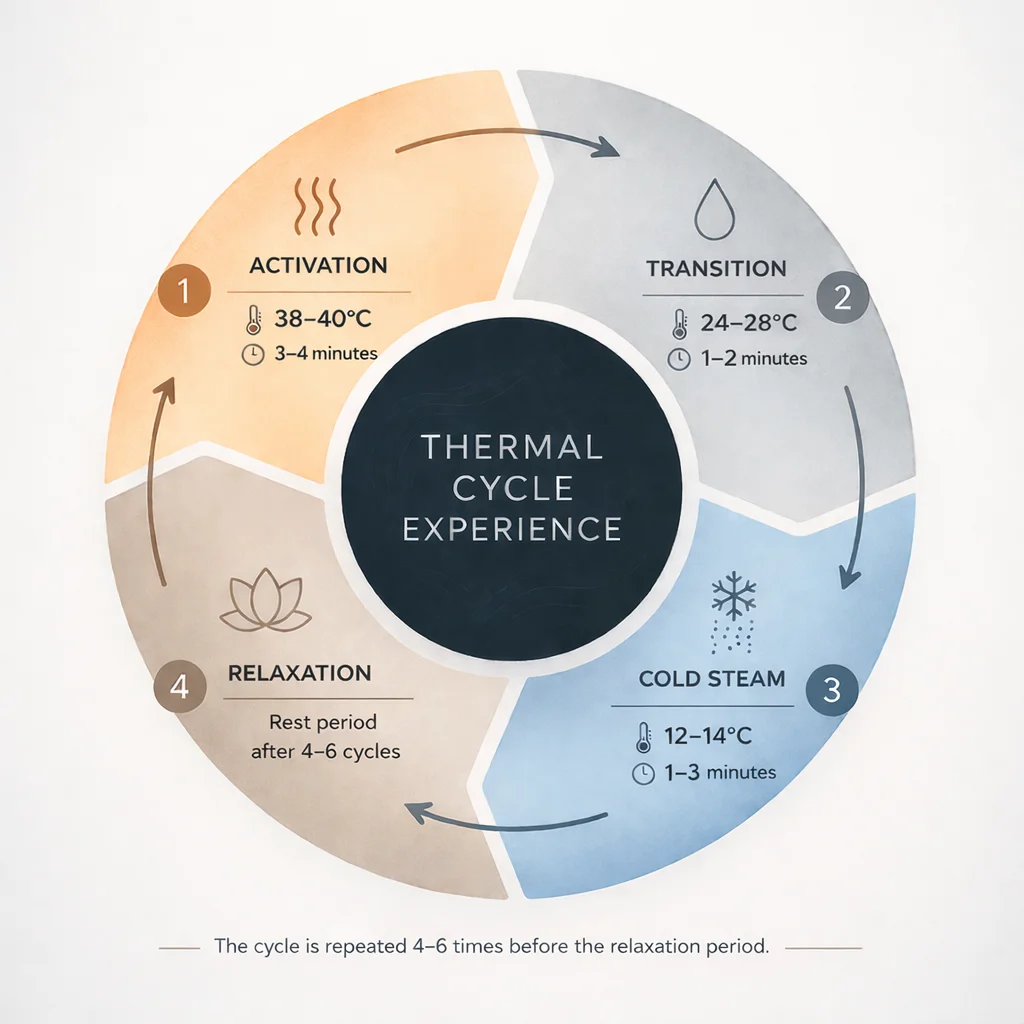
The active thermal sequence is repeated 4–6 times before the recovery phase.
The alternation of temperatures organizes a clearly structured experience of thermal contrast, with a smooth transition between warm and cold phases. This logic reinforces the coherence of the cycle and helps the unit deliver an experience with consistent functional behavior and a clear identity of use.
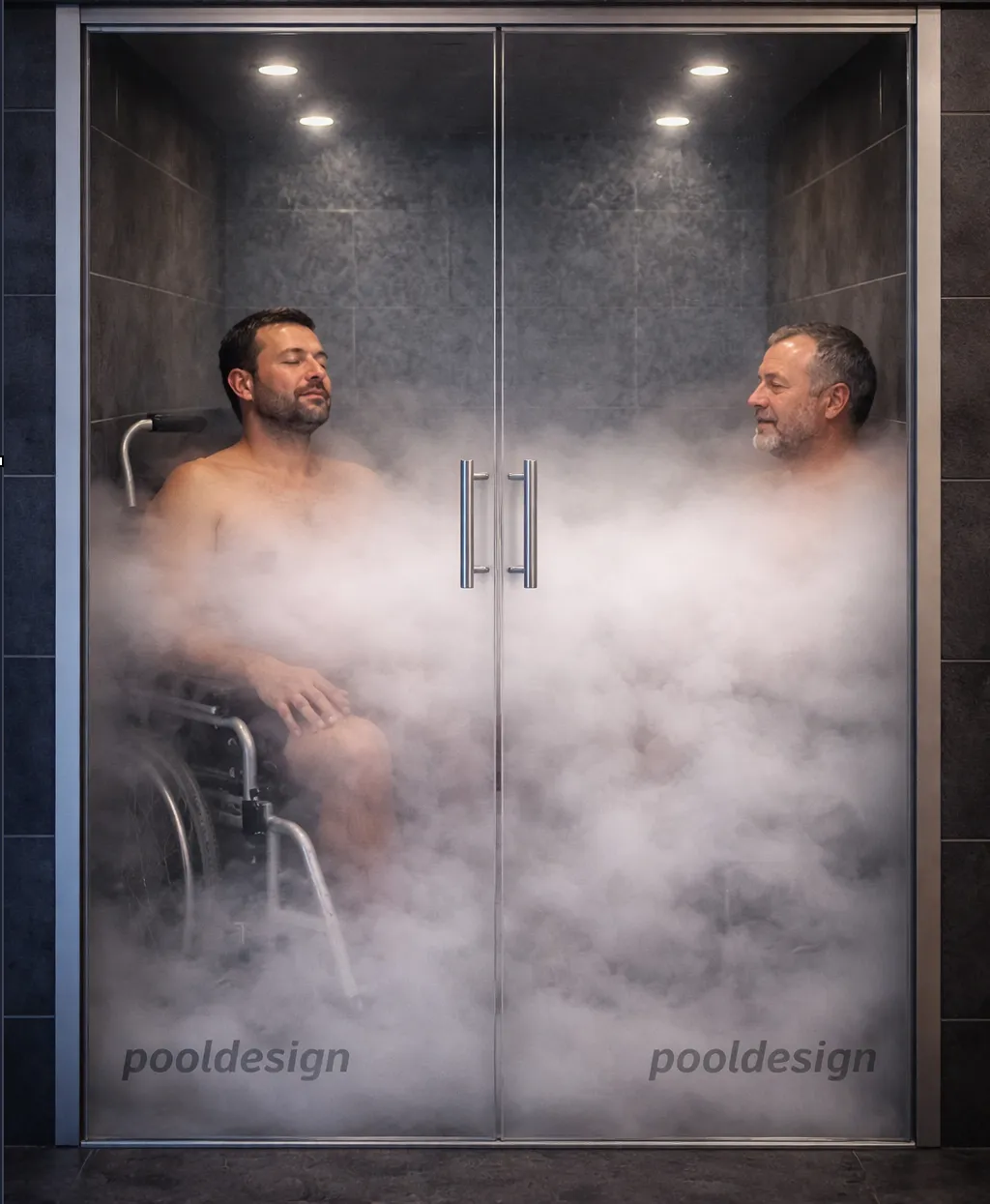
The architecture of the chamber allows the body to be exposed to the steam up to the shoulders, while the head remains outside. This ensures comfortable breathing with fresh air, greater staying comfort and a friendlier experience for a wider range of users.
For hospitality units and wellness centers, this design choice is associated with wider acceptance by an international audience, a friendlier sense of use and a provision for a more accessible experience, without losing the premium character of the facility.
The availability of different programs helps the unit to organize the use more flexibly, depending on the audience, the session duration and the functional model of the space.
Complete PoolDesign Thermal Cycle Experience program for a full thermal contrast experience.
Mode that focuses on the hot phase for short or targeted use.
Cold steam function for supplemental use or special thermal contrast protocol.
About 6.5 minutes per phase cycle.
4 to 6 times, depending on the selected operating program.
10 minutes to complete the experience smoothly.
40 to 50 minutes.
Controlled inhalation air renewal, uniform temperature distribution and humidity stabilization help ensure the experience remains consistent in daily operation. At the same time, water and steam are sterilized by UV radiation, supporting increased hygiene.
For the operator, this means better condition control, less variance in user experience, and safer integration of the system into a wellness center environment.
The lower energy requirement supports more efficient operation and more controllable operating costs compared to classic thermal installations, especially when the goal is to provide a premium experience with a more rational use of resources.
High consumption
High consumption
Low consumption
≈ 2 kW/h (2 person model)
The system is aimed at projects where the wellness experience must be combined with a clear functional structure, commercial value and clear differentiation in the market.
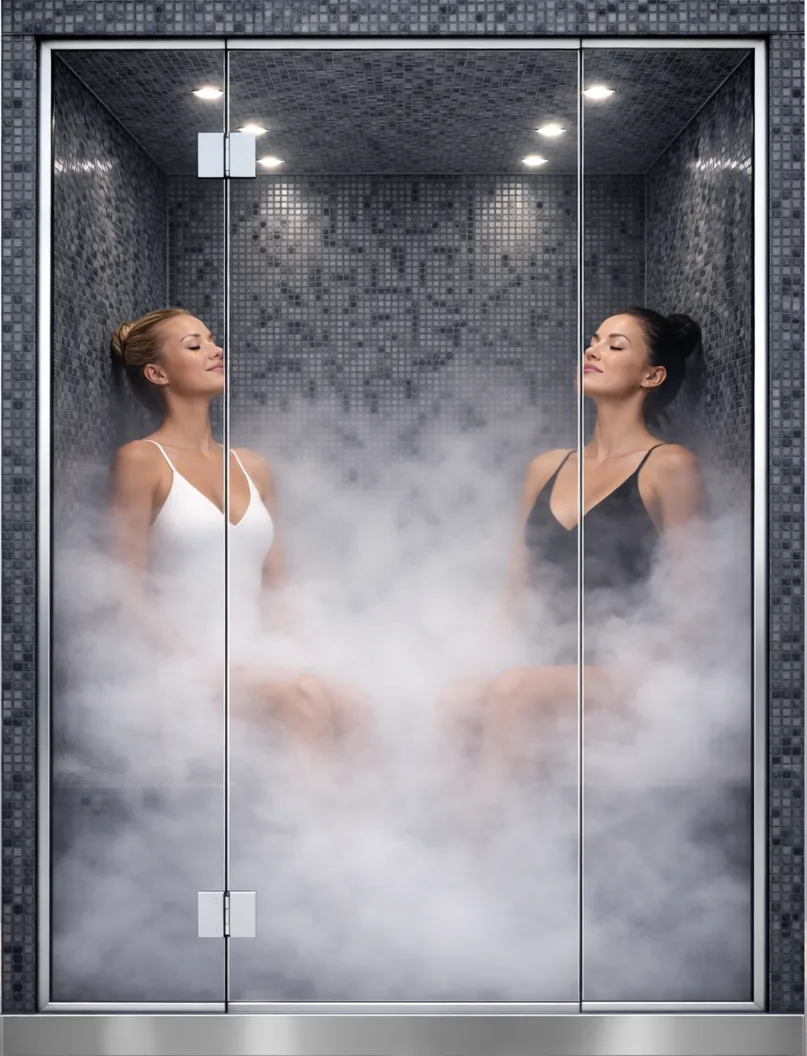
The proposed arrangement can be organized with 1 QuadBalance unit and 1 SoloFlow unit to increase the total service capacity within the same space. This composition allows for cleaner user flow, better session organization and more efficient use of the available footprint.
In a space of around 45–60 m², the system can be integrated consistently into a wellness environment, support different levels of use and act as a realistic installable solution for hospitality, wellness and rehabilitation projects.
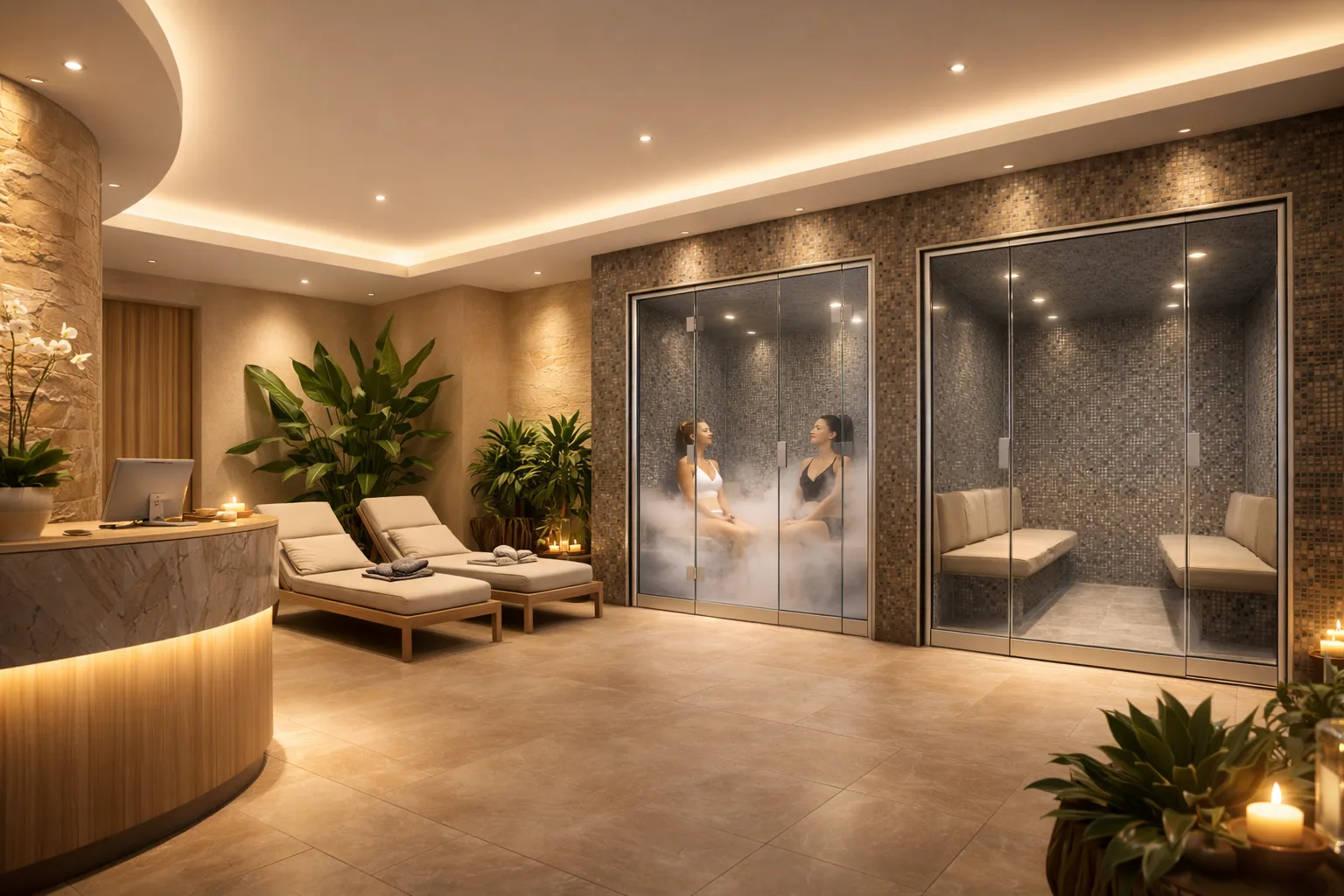
The final choice of model is formed after a project study, according to the capacity, spatial integration and installation plan.
Use for 1–2 people.
Use for 4 people.
Use for 6 people.
The commercial proposal is formulated after study and the final composition depends on the requirements of the project.
The premium identity of the experience, the clear structure of use and its potential integration into an organized wellness product create meaningful business potential for hotels, resorts and wellness centers. The following scenarios are indicative and based on operating assumptions that vary according to the market, the location of the unit, the pricing policy and the degree of utilization.
20 people / day
€60 per use
200 days of operation
Annual income: €240,000
35 people / day
€70 per use
250 days of operation
Annual income: €612,500
50 people / day
€85 per use
280 days of operation
Annual revenue: €1,190,000
The estimated net margin can be between 30% and 50%, depending on the operating model, location of the unit, pricing strategy and utilization rate. Payback time varies substantially from project to project and is affected by actual commercial and operational conditions.
The relevant scenarios should be treated as indicative projections of business dynamics and not as a binding performance forecast. The final financial evaluation can only be obtained through a specific project study.
This section brings together the key questions an owner, investor or hotel director asks before evaluating PoolDesign Thermal Cycle Experience as a business asset. It also gives technical partners the clarity needed for implementation.
Because it creates a new wellness experience category with a clearer commercial role than adding another amenity. The integrated system combines differentiation, session-based use and efficient footprint, so the investment can be evaluated through guest experience, revenue per m² and operational predictability.
A traditional spa often separates steam, cooling and recovery into different rooms. This concept structures steam, transition, cooling or cold vapor and recovery in one controlled environment, giving the property a clearer product, a more coherent guest journey and less fragmented space planning.
Inaction can look low risk, but wellness expectations and competitive sets continue to move. If nearby properties introduce memorable session-based experiences while yours remains conventional, differentiation becomes weaker and the wellness offer becomes easier to compare on price.
Return should be evaluated by model: capacity, price positioning, seasonality, occupancy, staffing and local demand. The structured 40–50 minute session gives management a clearer planning unit than open-ended amenities. It does not guarantee performance, but it gives measurable variables for investment assessment.
Because the phases take place in one controlled environment, the system can reduce the need for multiple separate thermal rooms. This helps a property plan valuable wellness area around revenue per m², guest flow and usable capacity, not only around a list of facilities.
Implementation starts with the available area, technical services, guest flow and intended operating model. The technical plan is translated into business meaning: what space is needed, how the session flow works, what infrastructure is required and how the project can be phased with confidence.
The system uses controlled phases for steam, transition, cooling or cold vapor and recovery. For the operator, this means more consistent sessions, clearer staff procedures and a repeatable premium experience instead of a guest journey that depends on how each visitor moves between rooms.
Daily operation is organized around sessions, defined duration, programmed phases, light cleaning between uses and scheduled maintenance. That structure reduces ambiguity for staff and supports predictable capacity planning, which matters as much as the technical installation itself.
Individual features can be copied more easily than an integrated experience. The strategic value sits in the sequence, spatial logic, operating protocol and way the experience is presented to guests. An integrated experience with a clear operating protocol is harder to replicate than a collection of isolated features.
The real risk is not only technical. It is installing a premium system without clear positioning, pricing, guest journey, staff process and commercial plan. A disciplined evaluation reduces that risk by testing whether the concept fits the property before it becomes a capital decision.
Start with the guest profile, the property positioning, the available space, the expected capacity, the pricing logic and the competitive context. A focused study can turn those inputs into a practical recommendation: proceed, adapt the concept or decide that it is not the right fit.
Download the PoolDesign Thermal Cycle Experience brochure in PDF format to review internally, share with partners and support initial project assessment.
Download business brochureIt includes a brief presentation of the solution, operational logic and business perspective.
If the solution is relevant to your concept, spatial integration or commercial use, the next step is a targeted discussion based on the specific data of your project.
We consider how the solution can be integrated from the initial study stage.
We evaluate whether it can be integrated into an existing wellness area with functional and commercial coherence.
We discuss whether the proposal makes sense for your audience, positioning and operation.
PoolDesign can assess whether the solution is suitable for your hotel, resort or spa, based on the available space, operating model and strategic positioning of the project.